Living on the Edge: River Country
Living on the Edge: River Country was a multi-year collaborative project that explored the relationships of Australian communities with freshwater ecological communities, with a particular focus on connecting to threatened species and places. This project considered what these places are like, why they matter and how we can protect and regenerate them.
The project brought together a wide range of community voices and perspectives—including cultural researchers, writers, curators, traditional custodians, artists, school children, policymakers, scientists and community conservationists—to share knowledge and explore ideas. Ultimately, it aimed to create both spaces and resources for a broad public dialogue on our changing relationships with watery places through a series of public and scholarly events, broadcasts, publications, and the development of educational resources.
This project ran from 2023-2026 and was developed by the National Museum of Australia (through the James O Fairfax Senior Fellow in Culture and Environment Program) and the Sydney Environment Institute at the University of Sydney, and was led by Kirsten Wehner (NMA), Cameron Muir (NMA), and Thom van Dooren (SEI).
The core of this project was generously supported by the James O Fairfax Foundation, the Australian Research Council (FT160100098, DP220101258), the National Museum of Australia, and the Sydney Environment Institute at the University of Sydney. Specific outputs were made possible by additional funding and support from Petaurus Education Group, the Cad Factory and a NSW Government Regional Arts Touring Fund grant.
Below is a list of the main outputs that were produced as part of this project as well as links to further information.
EVENTS
River Country community day
National Museum of Australia, Canberra
15 October 2023
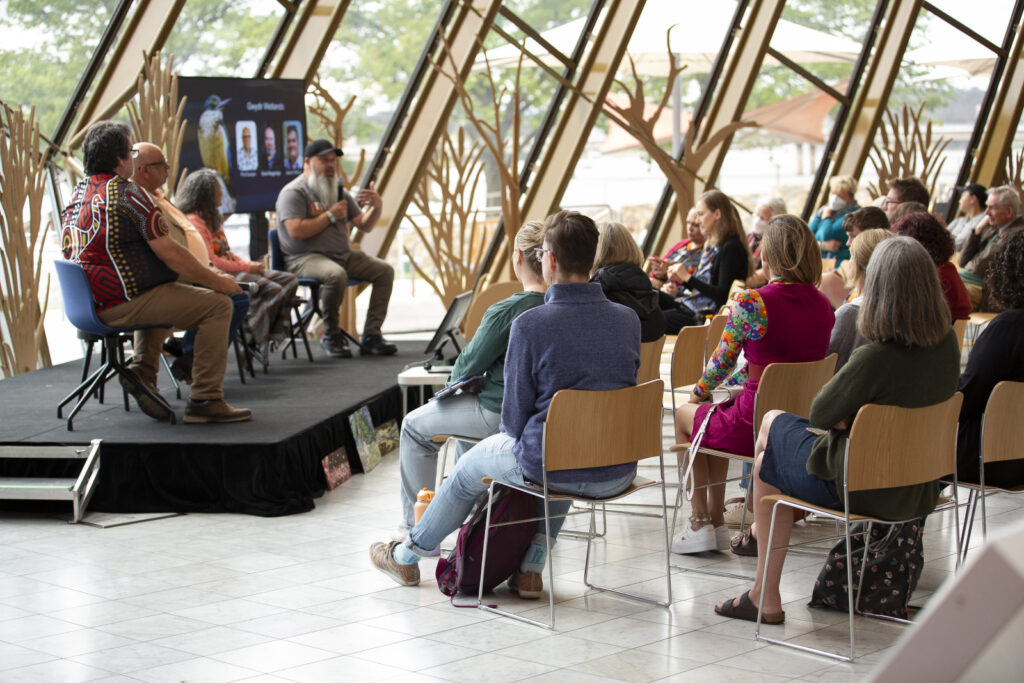
The River Country program launched with a community day at the National Museum of Australia in Canberra. This all-ages event brought together over 50 First Nations and non-Indigenous cultural leaders and around 2,500 visitors to participate in artworks, performances, conversations and workshops exploring the Murray-Darling system’s remarkable and threatened places.
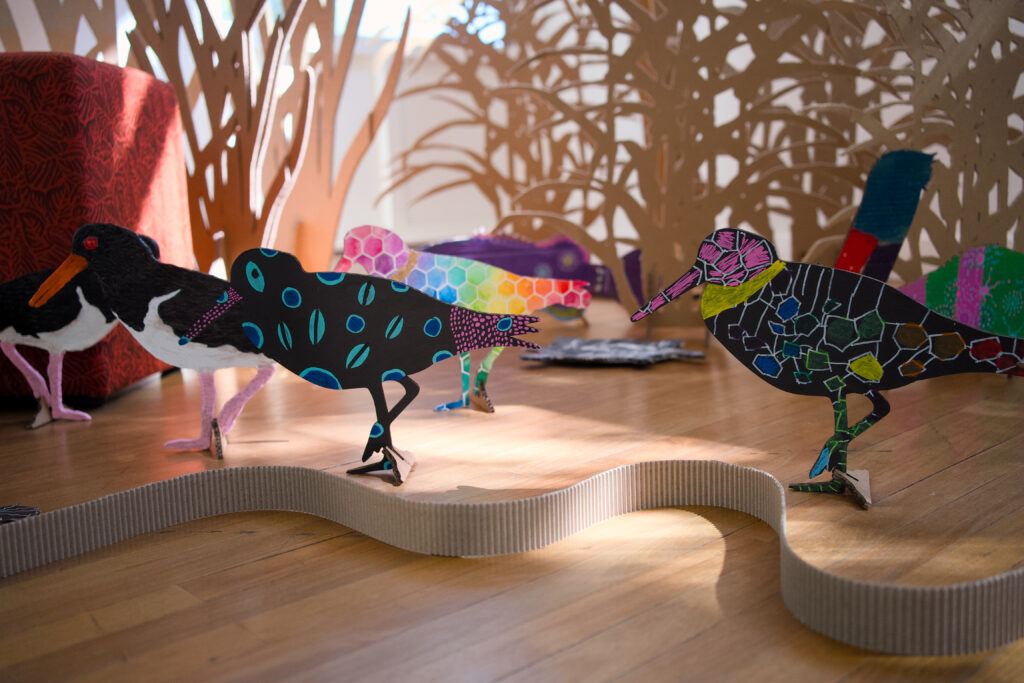
A specially commissioned art installation developed by S. A. Adair and Kirsten Wehner and incorporating works by over 90 artists and students from Murray-Darling communities transformed the Museum atrium into a flourishing ‘wetland’. Panel conversations featured Traditional Custodians, artists, designers, scientists, historians and curators explored river pasts and futures, while workshops invited visitors to take a walk on Country, explore watery worlds through platypus cyanotypes and collage and participate in river crafts such as weaving. First Nations troupe Dinawan’s Connection shared culture through dance while poets explored the question, ‘What is a river?’.
—
River Country tour
Produced in partnership with artist-run organisation, the Cad Factory, and education non-profit, Petaurus Education Group, the River Country tour invited communities to learn about, reflect on and share their stories about their local waterways. The tour was supported by a NSW Government through a Create NSW Regional Arts Touring Fund grant, awarded to the Cad Factory.
River Country visited three regional NSW areas, the Riverina, Far West and North West, including 12 communities. In each location, the experience included the wetland exhibition, local Elders leading events such as walks on Country and astronomy nights, film screenings and discussions and school student workshops. The tour welcomed almost 1500 participants, with some 500 students creating artworks sharing their river stories.
Further information: https://www.cadfactory.com.au/river-country-tour
—
Storytelling for lost and threatened places
An Environmental Humanities Symposium
University of Sydney
2-3 June 2025
This symposium explored how place-based stories shape our understanding of, and responses to, the biodiversity and climate crises.
As planetary-scale environmental transformations unfold in diverse and uneven ways, storytelling offers both opportunities and challenges for making sense of these changes. How do stories define, value, and contest places under threat? How might they resist loss, or alternatively, contribute to the creation of “sacrifice zones” and “shadow places”?
Further information: https://www.sydney.edu.au/sydney-environment-institute/events/2025/storytelling-for-lost-and-threatened-places.html
FILM
More Than a Fish Kill
Documentary, Ronin Films
Year: 2024
Runtime: 38 mins
Directed By: Otis Filley
Produced By: Vic McEwan, Kirsten Wehner
Trailer: https://vimeo.com/1082039808
More than a Fish Kill is an inspiring short-form documentary (38 mins) exploring how artists, fisheries managers and First Nations custodians came together in the aftermath of devastating fish kills along the Barka (Darling River) in far western New South Wales. These unlikely collaborators undertook a remarkable journey, turning these devastating ecological disasters into catalysts for cultural healing and revival. More than a Fish Kill shares how art, science and ancient knowledges were interwoven in the spirit of care, revealing new possibilities for honouring our places and communities in this time of environmental change.
More than a Fish Kill was co-produced by the National Museum of Australia, the Cad Factory and Otis Filley Studios.
Further information: https://www.cadfactory.com.au/more-than-a-fish-kill
To purchase the film, please contact Ronin Films: https://www.roninfilms.com.au/feature/19067/more-than-fish-kill.html
EDUCATIONAL RESOURCES
River Country: Connecting with Australia’s waterways
A learning resource for primary school classrooms (Years 3-6)
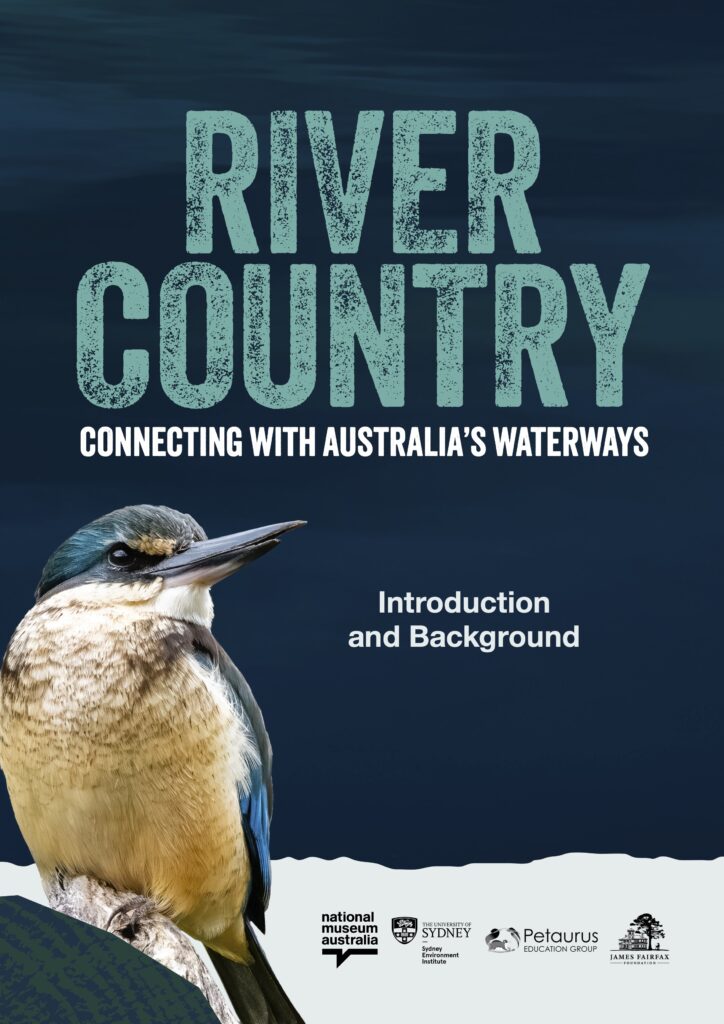
River Country: Connecting with Australia’s waterways develops student engagement with and understanding of national and local freshwater systems. Students explore these waterways as places of ecological, cultural, historical, emotional and imaginative importance for Indigenous and non-Indigenous Australians.
This learning resource invites students to explore rivers and other watery places as communities that include a diversity of plants, animals and people, all depending upon each other for life. The module asks students to consider how and why many of these places are threatened, and how the students’ own physical, cultural and spiritual wellbeing is interwoven with the health of watery places.
Drawing on a range of artefacts and stories from the National Museum of Australia’s collections, students begin by exploring the Murray-Darling river system as a major waterway with a complex cultural history. Students then focus on their local waterway, using a diverse range of research approaches to explore their place. Students discover how they can help care for their local waterway by creating and sharing stories about how it is important to them and how they belong to its community.
Available online: https://www.petaurus.org.au/river-country-connecting-with-australias-waterways/
—
River Country: Stories of change from the Murray–Darling river system
A video virtual excursion for primary school aged children.
Visit the National Museum’s Great Southern Land gallery and join Museum Education Officer Brendan on a journey through time as he explores the Murray–Darling river system and encourages students to think about the rivers, creeks and waterways in their own local area. Objects from the Museum’s collection help tell the story of the Murray–Darling river system, which stretches from southern Queensland through much of New South Wales and Victoria, to South Australia. From deep time to the present, these objects reveal how River Country has changed through interactions between people, other animals, plants and water. Throughout the video, students take part in activities, discussion questions and a guided drawing exercise. The video also shares the story of First Nations students honouring the Barka (Darling River) near Menindee in western NSW after low water flows caused large-scale fish deaths in 2019.
Available online: https://digital-classroom.nma.gov.au/videos/river-country-stories-change-murray-darling-river-system-virtual-excursion
BROADCASTS
More than a fish kill
ABC Radio National, Big Ideas
1 November 2023
Speakers: Barbara Quayle, Neville Bamblett, Matt McLellan, Vic McEwan
Sometimes an event so big happens that it leaves everyone gasping in its wake. In this case, more than million fish were left gasping too. A stunning story of how a community rallied. At its heart is healing country, art, science, and ancient knowledge. In the Summer of 2018-2019 and again in 2023, mass fish kills left communities along the mighty Baaka / Darling River — one of Australia’s most important river systems — devastated. The scenes of floating white carcasses captured attention worldwide. What happened next? And how were lives transformed in the process?
Available online: https://www.abc.net.au/listen/programs/bigideas/darling-river-baaka-fish-kills-menindee-barkandji-science/102960318
—
The radical work of mourning
ABC Radio National, Big Ideas
26 June 2024
Speakers: Thom van Dooren, Blanche Verlie, and Zoe Sadokierski
Join Natasha Mitchell and guests for a poetic discussion on the ways you can create space to grieve for species that are going, going, gone. Powerful interests collude to tell us that expressing emotion is hysterical, and that humans are separate from Nature, but proper mourning paves the way for what to do next — and places us right back where we belong.
Available online: https://www.abc.net.au/listen/programs/bigideas/-the-radical-work-of-mourning-a-toolkit-for-planet-dwellers/103902812?utm_content=link&utm_medium=content_shared
PUBLICATIONS
Mourning in a time of planetary crisis: Making room for grief
The Griffith Review, 92 (2026)
Authored by: Thom van Dooren, Blanche Verlie, Zoë Sadokierski
Available online: https://www.griffithreview.com/articles/mourning-in-a-time-of-planetary-crisis/
—
Developing the public environmental humanities: Challenges, opportunities, and lessons
Resistance: A Journal of Radical Environmental Humanities, 11, 6-44 (2024).
Authored by: Thom van Dooren, Drew Rooke, Zoë Sadokierski, Natalie Osborne, Bethany Wiggin, Marco Armiero, Stephen Muecke, Emily O’Gorman, Joni Adamson, Sebastián Ureta, Jennifer Deger, Yen-Ling Tsai, Cameron Muir, Kirsten Wehner, Matthew Kearnes, Peter Minter, Kate Rigby
Available online: https://muse.jhu.edu/article/953845